How to log a meal someone else cooked
6 min read
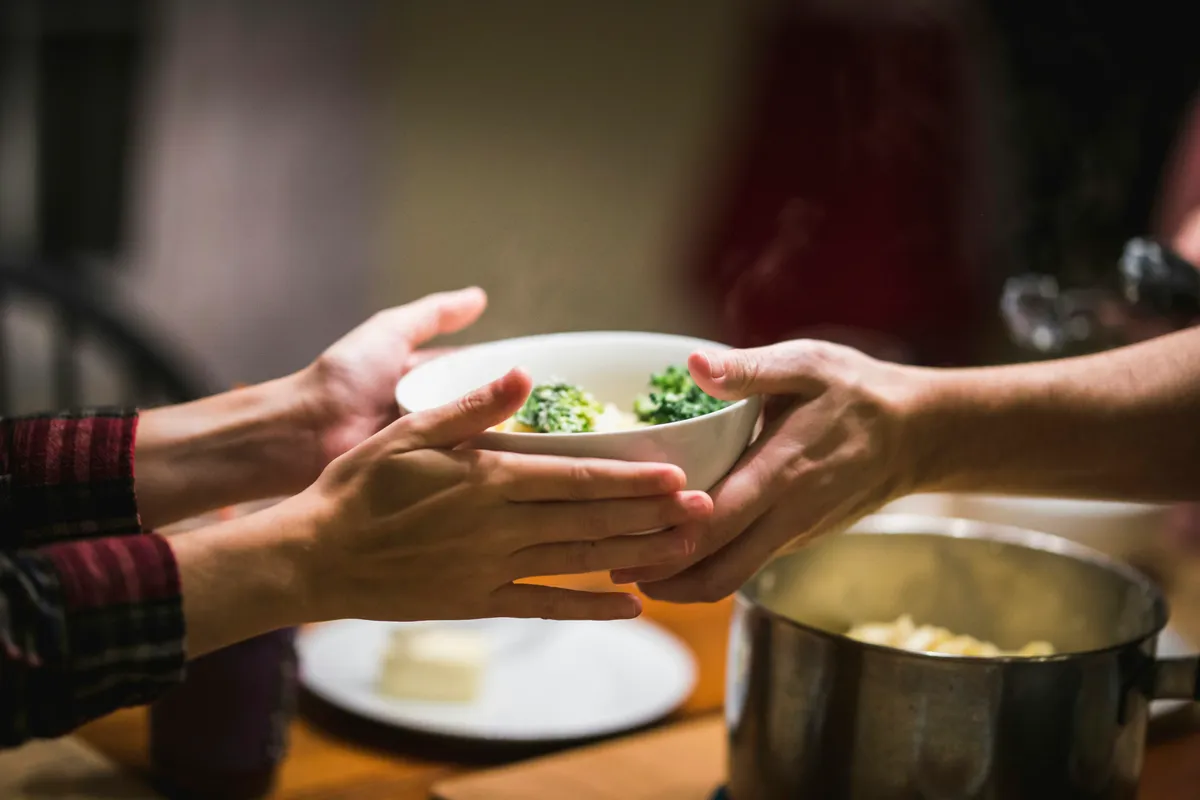
Your mother-in-law has made lasagne. There is no label on it, no menu, and no polite way to stand in her kitchen weighing the white sauce. You eat it, you say it was lovely, and later that evening your food log has a hole in it the shape of a Sunday lunch. Meals other people cook for you are the ones no tracker was designed around, and they are a bigger part of a normal life than the apps like to admit.
We have written about restaurants and takeaway before. This is the other kind of meal you did not make: a friend's dinner, a family table, the colleague who brings in a tray of something. No chain publishes its numbers, and the cook is someone you would rather not cross-examine.
Why "I'll just skip this one" is the wrong call
It feels honest to leave the entry blank rather than invent a number. It is the opposite. A blank is also a number: it says zero, and zero is further from the truth than any guess you would have made.
People are already inclined to remember less than they consumed. In one much-quoted study, adults who were sure they were eating very little turned out, when everything was measured, to be reporting only about half of what they actually consumed. They were not lying. They were remembering the way everyone remembers food: the main thing, minus the seconds, the bread and whatever was passed round afterwards. A meal you never write down at all is that same habit taken to its end.
Take the photo first
The single most useful thing you can do takes two seconds and nobody at the table will mind: photograph the plate before you start. Memory is poor at portions and worse a few hours later. A picture is not.
Researchers have leaned on this for years. When trained observers estimated portions from photographs of cafeteria meals, their figures tracked the weighed portions closely. A later method had people simply send phone photos of their plates before and after eating, and the intake worked out from those pictures came in less than a tenth below what the kitchen scale said. A photo is not a lab. It is a great deal better than a recollection.
Then work out how much it was
Start with the lasagne, because it is the easy case. It is a dish every tracker already knows, so what went into it is not your problem. In the reference tables a meat lasagne runs from about 130 calories per hundred grams for a supermarket one to about 185 for a restaurant's, and a home cook with a generous hand lands near the top. The only thing you have to supply is the size of your piece.
The baking dish does that for you. An ordinary family-sized dish holds a little over two kilos of lasagne. Cut into six, each piece is about 350 grams. Cut into eight, about 270. So a piece from a dish of six is somewhere between 450 and 650 calories, and a piece from a dish of eight between 350 and 500. Look at your photo, count the cuts, and log "meat lasagne, 350 grams". That is the whole job, and it took a minute.
When the dish has no name
A stew, a traybake, somebody's famous casserole: no tracker has an entry for those, so you log what was in them instead. Three questions cover almost any plate, and your own hand is enough of a measure to answer them.
- How much meat or fish? A piece the size of your palm, fingers not included, is about 85 to 100 grams cooked. That is roughly 100 calories of white fish, 150 of chicken breast, and 200 or more of salmon, beef or lamb.
- How much rice, pasta or potato? A heap the size of your closed fist is about a cup, or 150 grams cooked. That is roughly 200 calories of rice, a little more of pasta, and about 130 of boiled potatoes.
- Where is the fat? This is the part you cannot see, and the part that decides the total. Count it in tablespoons. A tablespoon of oil or butter is 100 to 120 calories, a tablespoon of cream about 50, and a small handful of grated cheese about 120. A portion of anything creamy, cheesy or fried has at least one of those in it, and often two.
Vegetables barely move the number unless they were roasted in oil or dressed, and then it is the oil you are counting.
So a plate of chicken in a cream sauce with rice becomes three lines: chicken, one palm; rice, one fist; cream, two tablespoons. About 150, 200 and 100, which makes 450 calories. A hand is not a scale, and yours is not the size of mine. But those three lines are a real entry, and they sit far closer to the truth than the blank you were about to leave.
Two things that go missing
- Everything after the first plate. Seconds are a second entry. So is the bread that went round, and the glass that was refilled while you were talking.
- The cook's generosity. People who cook for guests use more butter, cream and oil than they would on a Tuesday. That is what makes it a treat. And remember the study above: left to instinct, people log too little, almost never too much. So when you are torn between two sizes, log the bigger one.
You are allowed to ask one question
Not ten, and not "how many grams of oil". One. "This sauce is great, what's in it?" is a compliment, and people who cook love answering it. The answer you are listening for is whether there was cream, butter or cheese involved, because that is the fat question from above, and it is the one your eyes could not answer.
What you do not do is bring a scale, ask for the recipe mid-meal, or eat around the potatoes. The dinner is for the people as much as for the food, and a log that makes you a worse guest will not survive the season.
Roughly right, written down
Do it the same evening, while the photo still means something to you. Give it two minutes, accept that it is an estimate, and close the app. One estimated lunch in a week of logged meals does not blur the picture. What blurs it is a week that reads lower than it was, every week, because the meals with other people in them never made it onto the page.
Sources
- MedlinePlus (US National Library of Medicine), "Portion size" - the palm and the fist as measures. medlineplus.gov/ency/patientinstructions/000337.htm
- USDA FoodData Central - the reference values behind the calorie figures. fdc.nal.usda.gov
- Lichtman SW et al., "Discrepancy between self-reported and actual caloric intake and exercise in obese subjects", The New England Journal of Medicine, 1992. pubmed.ncbi.nlm.nih.gov/1454084
- Williamson DA et al., "Comparison of digital photography to weighed and visual estimation of portion sizes", Journal of the American Dietetic Association, 2003. pubmed.ncbi.nlm.nih.gov/12963941
- Martin CK et al., on the remote food photography method - phone photos of meals, checked against the same food weighed - British Journal of Nutrition, 2009. pubmed.ncbi.nlm.nih.gov/18616837
New posts by email
One email when a new post lands. Nothing else, and an unsubscribe link in every one.
Prefer a feed reader? RSS feed →